
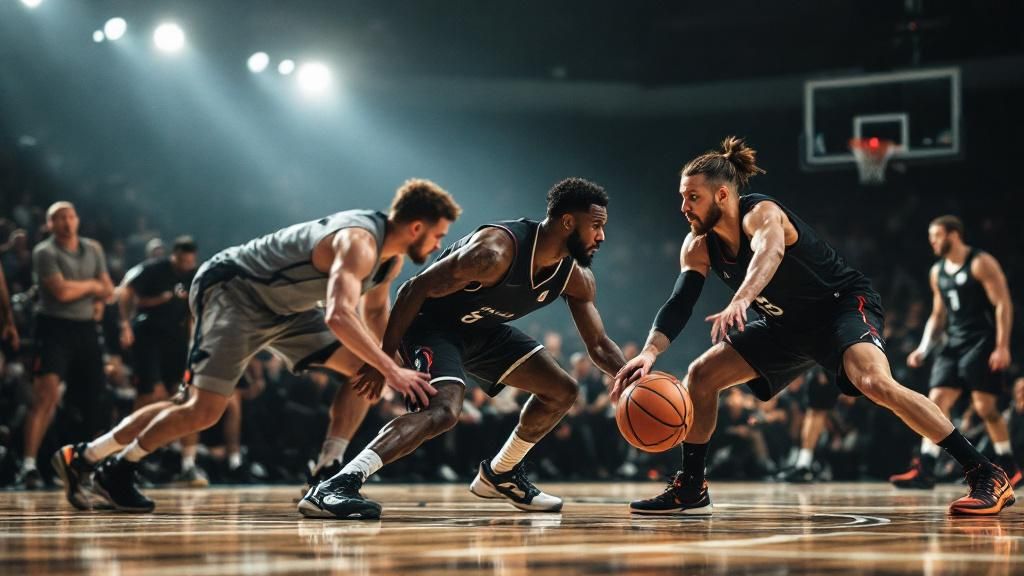
The screen and roll remains basketball’s most potent offensive tool, yet only the world-class point guards fully command its sophisticated nuances. From Stephen Curry’s devastating spacing to Luka Dončić’s inventive finishing, the world’s best orchestrate this fundamental play with exceptional sophistication. This article explores the advanced techniques that separate championship-level creators from the competition, assessing how top playmakers disrupt defensive coverage, unlock scoring avenues, and maintain competitive dominance through refined pick and roll execution at the elite level.
Understanding the Essential Basics of Pick and Roll Mastery
The screen and roll exemplifies basketball’s most essential and deeply effective offensive action, serving as the bedrock of contemporary offensive strategy at the highest levels. Developing proficiency in this two-man game demands sophisticated comprehension of positioning, timing, and defensive recognition. Top ball-handlers understand that effective implementation surpasses simple mechanical repetition; it requires nuanced interpretation of defensive positioning and instantaneous decision-making. The best practitioners leverage the screen and roll not simply as a scoring mechanism, but as a multi-purpose weapon for creating benefits that extend across entire attacking structures, generating additional chances for fellow players and prompting defensive adjustments that expose vulnerabilities.
Championship-calibre point guards set themselves apart through their ability to manipulate pick and roll elements with remarkable precision and creativity. They understand that screen positioning, timing of the roll, and speed of decision-making fundamentally determine outcomes against complex defensive strategies. Comprehending defensive coverages—whether switching, hedging, or pressing—allows top-tier facilitators to anticipate opponent reactions and exploit gaps accordingly. The basis of success lies in acknowledging that the pick and roll’s genuine strength emerges from combining technical proficiency with basketball intelligence, enabling point guards to orchestrate offences with command and regularly produce high-quality scoring chances that sustain competitive advantage throughout challenging campaigns.
Perfecting Spacing and Positioning Techniques
Elite point guards grasp that spacing and positioning establish the core of successful pick and roll execution. By maintaining proper spacing from teammates and the ball handler, guards open up passing lanes that opposition cannot sufficiently protect. The most accomplished playmakers position themselves to expose defensive vulnerabilities, putting defenders into uncomfortable rotations. This strategic awareness allows them to read defensive reactions milliseconds faster than their opponents, enabling accurate decision-making that sets apart elite performers from capable players in high-pressure competitive environments.
Positioning extends beyond mere floor spacing; it encompasses predicting defender reactions and adjusting accordingly. Top-tier point guards constantly evaluate spatial positioning, identifying how their positioning shapes player options and points-scoring possibilities. By executing precise positioning and keeping track of all five defenders, elite guards manipulate spacing to create advantageous matchups. This refined method to positioning converts the pick and roll from a simple offensive action into an effective offensive weapon, permitting teams to continually create efficient scoring chances against even the toughest defensive schemes.
Advanced Decision Making and Reading Defences
Elite ball handlers demonstrate outstanding defensive reading capabilities during pick and roll situations. These maestros immediately recognise whether defenders employ switching, aggressive blitzing, or coverage adjustments, then capitalise on weaknesses with pinpoint accuracy. By studying defensive tendencies in advance and reading live adjustments, championship-calibre playmakers regularly find available teammates or create advantageous scoring situations. This mental processing happens in milliseconds, converting the pick and roll play into a chess match where superior intelligence outmatches defensive schemes.
The most elite point guards create sophisticated trigger mechanisms for decision-making within pick and roll scenarios. Rather than set plays, they leverage fine-grained situational indicators—defensive placement, player spacing, and help rotation timing—to identify best results. Understanding when to attack downhill, when to dump to the roller, or when to reset and initiate secondary actions distinguishes exceptional decision-makers from competent ones. This flexibility confounds defensive coordinators, as their systems become predictable against genuinely elite creators who continually adapt their responses.
Mastering sophisticated pick and roll techniques ultimately demands cultivating basketball’s premier intellectual requirement: reading defences with natural exactness. Championship point guards convert split-second reads into championship-winning plays through relentless practice, video analysis, and match-day involvement. This combination of technical excellence, athletic ability, and intellectual edge establishes championship calibre, enabling floor operators to regularly outsmart opponents and provide ongoing winning results at the game’s pinnacle.
